// WHAT_AGENTS_KNOW
WHAT DO YOUR AGENTS
KNOW?
Right now, probably nothing from last week. Alexandria gives your agents a memory that learns, consolidates, and reasons — so every interaction builds on the last.
Documents are what survived. Reasoning is what mattered. Alexandria remembers both.
// ALEXANDRIA
Alexandria is our agent memory accelerator — a proven architecture we customise and integrate into your stack. It doesn't just find documents. It builds a living knowledge graph that captures facts, reasoning, and decisions, understands how they connect, and gets smarter every day without anyone telling it to.
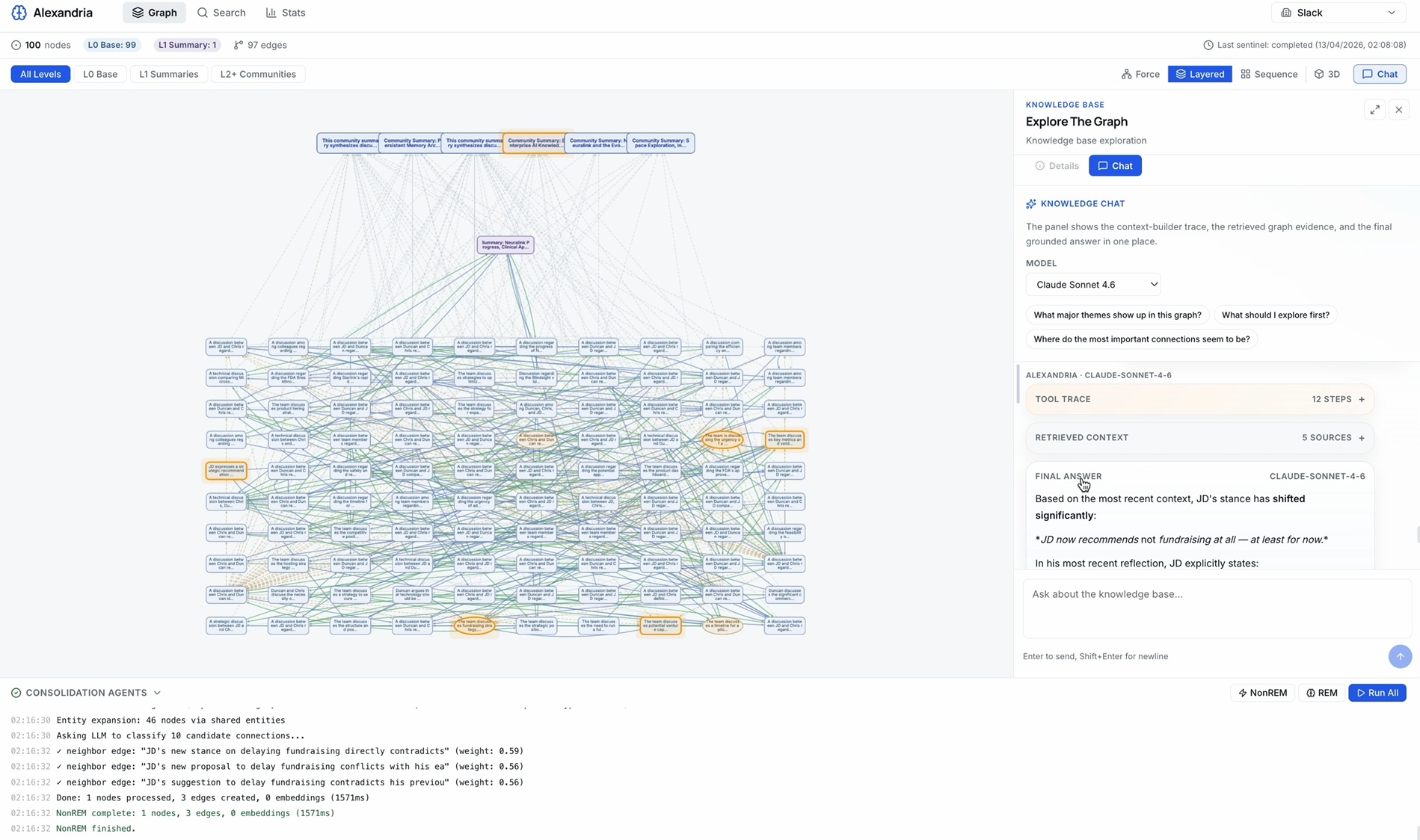
Alexandria's knowledge graph in action — nodes, edges, consolidation agents, and the query interface
// HOW_IT_LEARNS
It Learns Like a Brain
Alexandria's architecture is inspired by how human memory actually works — three consolidation stages that mirror the neuroscience of sleep.
Always listening. Every conversation, every document, every decision gets observed, expanded, and stored with extracted entities and relationships. Like your brain during the day — taking everything in.
Coreference resolution makes every memory self-contained. Hypothetical questions bridge the gap between how knowledge is stored and how it's later queried.
Connects new memories to existing ones. Finds semantic neighbours, traces entity relationships, and builds weighted edges between related knowledge. The graph takes shape.
Triggered by volume and importance — high-salience observations get connected faster. Entity graphs expand the search beyond simple embedding similarity.
The creative leap. Abstracts patterns across clusters, discovers non-obvious connections between topics, compresses dense knowledge, and supersedes outdated facts. The graph gets wiser.
Hierarchical clustering builds a multi-level structure. Cross-topic grafting surfaces connections no one asked for. Compression creates summaries at every level of abstraction.
// SAME_FACTS_DIFFERENT_LENS
Every Agent Sees Differently
Each agent gets a soul — a personality and worldview that shapes how it interprets shared knowledge. The same facts, through different lenses.
// SHARED KNOWLEDGE
Patient: 58-year-old woman. Diagnosed with lung cancer in February. Started on a combination of immunotherapy and chemotherapy in March. At her week 4 check-in, she reported persistent fatigue and nausea.
“Her genetic profile suggests lower response rates to immunotherapy — approximately 35% in comparable cases. The combination protocol is standard but aggressive. Fatigue at week 4 is within expected parameters. Recommend maintaining current dosage and reassessing tumour response at the 8-week scan before considering alternatives.”
“Persistent fatigue and nausea at week 4 — these side effects can seriously affect quality of life and whether she continues treatment. Recommend reviewing her anti-nausea medication now, not at the next appointment. Ask her directly how the fatigue is affecting her daily routine. If she's struggling to manage normal activities, consider a dose adjustment rather than waiting for the 8-week scan.”
Same patient record. Same knowledge graph. Different expertise, different priorities, different actions. This is what it means for agents to have their own perspective.
// UNDER_THE_HOOD
What Makes It Work
Provenance
Every claim traces back to a source document, email, or conversation. Nothing is asserted without evidence. Every edge in the graph has a claim explaining why it exists.
Permissions
Graph nodes inherit access controls from your existing systems. If you couldn't see the original email, you can't see the reasoning extracted from it.
Supersession
Facts change. Alexandria doesn't delete — it supersedes. The graph knows what was true, what replaced it, and why. Both versions are preserved.
Hierarchical
Multi-level clustering gives your agents both the zoom-out view (themes across the organisation) and the zoom-in (the specific email that changed the decision).
// GO_DEEPER
How We Think About Agent Memory
Alexandria is built on deep research into how machines should remember. This guide explains the architecture behind every engagement.
Technical Guide
Agent Memory Systems — Beyond Vector Databases
Why vector databases aren't enough. How context graphs capture reasoning, not just documents. The retrieval architecture that makes Alexandria work. And what “learning from sleep” means for agent memory consolidation.
[ READ_THE_GUIDE → ]
Your agents are only as good as what they remember.
Build Your
Agent Memory
We customise and integrate Alexandria into your agent stack — adapted to your data sources, your permissions model, and your workflows.
Seed
Ingest your existing knowledge — documents, emails, meeting notes, interviews. Build the initial context graph. 4-8 weeks.
Connect
Wire Alexandria into your agents and tools. Your team starts querying immediately. Your agents start reasoning with context. 8-12 weeks.
Grow
The graph grows with every decision, every interaction. Background consolidation runs overnight. Your agents are measurably smarter every Monday than they were on Friday. Ongoing.
What you get
- —A context graph seeded from your existing knowledge
- —Agents that reason with your organisation's full context
- —Provenance on every claim — traceable back to source
- —Per-agent perspectives — same facts, different expertise
- —A system that compounds — smarter every week it runs